Should YouTube Thumbnails Have Faces? A Practical Test
YouTube thumbnails do not always need faces. Learn when a person helps the premise, when the subject should lead, and how to test the choice.
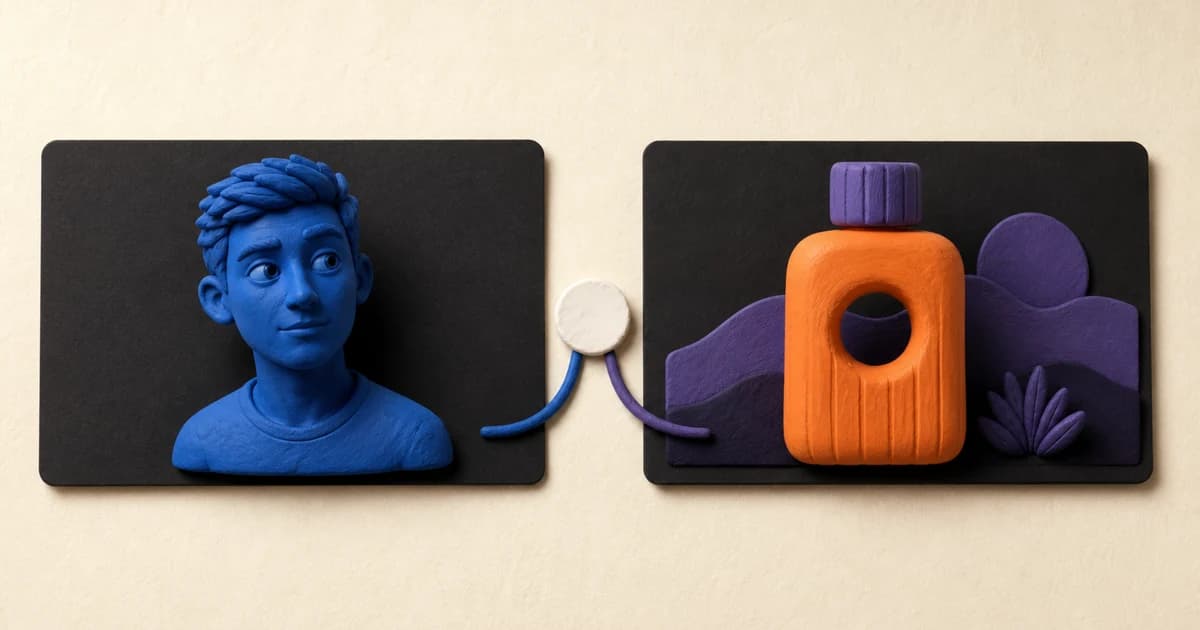
YouTube thumbnails do not always need faces. Use a face when the person, their emotion, identity, relationship, or point of view helps explain the video's promise. Leave it out when the product, place, result, or scene communicates the idea faster, then test genuinely different concepts with your own audience data.
The useful question isn't "do faces work?" It is "what would this face tell the viewer?" A face can identify a familiar host, make a reaction legible, or show that a relationship is the story. It can also occupy a third of the frame while saying nothing. If the video is really about a phone, garden, game update, or room transformation, that subject may deserve the space instead.
That distinction matters for faceless creators and smaller channels. You don't need a recognizable personal brand before a person can be useful. But an unfamiliar portrait needs to communicate something without recognition. It should clarify the role, emotion, conflict, or human stakes. "There was room for my cutout" is not a job.
Why face counts cannot answer the performance question
Current thumbnail guides often start with a count: a large share of selected breakout videos used faces, or face thumbnails had a higher average click-through rate in a collected dataset. Those findings can be useful leads. They are not instructions to paste a face into the next design.
A public prevalence count has no counterfactual. We see the thumbnail a creator published, not the equally polished no-face version they might have tested. Breakout samples also begin with successful videos, where topic demand, title, distribution, audience fit, and viewing history are already mixed together.
Even a dataset that includes creator-reported CTR needs more context before it becomes a rule. Were face and no-face thumbnails tested on the same videos, at the same time, to comparable audiences? Was the person the subject of the video? Did the no-face version use an equally clear product, place, or result? Without those controls, "face present" can stand in for several other differences.
YouTube's own guidance is more situational. It suggests that familiar people may matter to subscribers, while actions and emotions can help casual viewers understand a premise. It also says audience taste varies and tells creators to measure thumbnail-title performance in their own Analytics.
So treat public patterns as concept research. Your own concurrent test is where a performance claim begins.
What our 36-thumbnail sample showed
On August 7, 2026, we captured 36 entries from ThumbnailUp's live gallery. We kept the first six latest results from Tech, Gaming, and Lifestyle under separate no-face and face-present filters. That produced an API-level split of 18 face and 18 no-face entries, with 12 examples from each category.
This was a fixed convenience sample, not a study of YouTube as a whole. It cannot estimate how common faces are. It does not reveal private CTR or show that a face caused views.
It did reveal how much information the binary label hides.
The no-face examples still had obvious subjects. Tech used phones, laptops, a watch, and other devices. Gaming used a console, characters, game scenes, and an event label. Lifestyle used homes, interiors, a garden, and collectible cards. None of those images was waiting for a portrait to become meaningful.
The face-filter group did several different jobs. Some used a reaction to frame surprise, doubt, or concern. Others used a host beside a product, a family or couple to establish relationship context, or a group lineup to identify the people in an event. In a few examples, the person was small and the object or scene still carried most of the premise.
Eight of the 18 face-filter entries contained two or more detected faces. The automated emotion labels ranged from neutral and happy to shocked, curious, intense, and sad. "Use a face" does not tell you whose face, how many people, what emotion, or why the viewer should care.
The best counterexample came from the filter itself. Two results labeled as having one face were product shots with hands and no identifiable face when we inspected the source images. We kept them in the sample. After visual review, the set contained 16 identifiable-face entries and 20 without one.
That is a small research lesson with a bigger consequence: inspect the image before turning a tag or count into advice.
When a face is the right subject
A face earns space when the person is part of the video's information, not decoration added after the concept is finished.
The person is the story
Interviews, reactions, personal updates, challenges, collaborations, and relationship stories often need people. Removing the face could remove the main subject. A two-person image may explain the relationship faster than either name in the title.
The emotion changes the premise
A product alone can say "review." A real expression can add regret, relief, disbelief, or concern. The emotion should match a moment the video delivers. Forced surprise is not automatically clearer than a neutral product shot.
The viewer recognizes the person
Returning viewers may read a familiar host as a quick channel cue. YouTube specifically points to familiar people as something subscriber-focused packaging can use. Recognition is useful context, but it is not a substitute for a video idea.
The person provides a point of view
Sometimes the face says, "this is my experience with the subject." That can help opinion, experiment, or commentary videos where the person's judgment matters. Keep the product or event visible enough that a new viewer still understands what the judgment is about.
When the subject should lead instead
Start without a face when another visual answers "what is this video about?" more directly.
The object is the reason to watch
A new device, unusual tool, meal, collectible, or physical result can be the strongest focal point. An unrelated portrait may shrink the thing viewers came to inspect.
The place carries the promise
Travel, property, garden, architecture, and room-transformation videos often depend on the setting. If scale, condition, or atmosphere is the hook, let the viewer see it.
The scene explains the event
Game updates, sports moments, demonstrations, and before-and-after stories can use the action or result as evidence. A face in the corner may add intensity, but it may also compete with the useful detail.
The person would create ambiguity
An unfamiliar face can confuse the cast. Is this the host, the person being discussed, an expert, or a character from the story? If the viewer needs the title to resolve that confusion, the portrait has made the package slower.
No-face does not mean no emotion. A damaged object, empty room, dramatic landscape, or visible result can carry tension without borrowing a reaction from someone else.
The recognition question for smaller and faceless channels
Smaller creators sometimes hear two incompatible rules: show your face to build recognition, but don't show it because nobody recognizes you yet. Both skip the actual video.
Recognition can grow through repeated, useful appearances. It does not need to exist before the first face thumbnail. The face still needs a job for a new viewer, though. A baker holding the failed result, a reviewer examining the product, or two collaborators facing the same problem can make sense without fame.
A generic headshot beside an unrelated subject is different. It asks a stranger to care about the person before the thumbnail explains why.
Faceless channels have the same test. "Faceless" does not forbid every human in an editorial image. It usually means the creator does not build the channel around their own on-camera identity. Use people only when they truthfully represent the video's subject and you have the right to use the image. Do not manufacture a fake host, copy a recognizable creator's expression, or imply an endorsement.
A four-question face-versus-no-face test
Use this before choosing a crop.
1. Is the person part of the promise?
Name the job: identity, emotion, relationship, reaction, authority, or point of view. If you cannot name one, remove the face and see what becomes clearer.
2. What is the strongest alternative subject?
Try the product, place, result, action, or contrast. Do not compare a polished portrait against an unfinished object shot. Both concepts need one clear focal idea.
3. Does the choice survive at feed size?
Shrink both versions. Can you still identify the person or subject? Does the expression remain legible? Does a group turn into a row of tiny heads? Check the final title with each image, because the two arrive as one package.
4. Are the concepts different enough to teach you anything?
Changing only the crop by a few pixels is not a face-versus-no-face test. Build one honest people-led concept and one honest subject-led concept. YouTube's native test can compare up to three title and thumbnail variants for eligible creators and reports the result by watch-time share.
The outcome belongs to that video, audience, and traffic mix. Record it as a channel learning, not a law for every future upload.
How to compare face choices in ThumbnailUp
ThumbnailUp's public gallery lets you browse real thumbnails by face count, emotion, category, and other visible traits without an account. Keep the comparison inside one relevant category, open each result with its title and channel context, and record what the person or non-person subject actually communicates.
Do not stop at the filter label. Our sample retained two face-filter false positives that only became obvious during visual review. Check the image, then look for a counterexample to your first rule.
A small observation sheet needs only a few fields:
- source URL and publication date;
- visible subject;
- number of identifiable faces;
- emotion or relationship, when relevant;
- what the thumbnail adds beyond the title;
- the strongest plausible no-face or face alternative.
This is the same reason a structured thumbnail research process is more useful than a folder of random references. You leave with a testable concept instead of a layout to copy. If text competes with the face or subject, use the separate text-versus-no-text decision to simplify the package.
ThumbnailUp shows public context and channel-relative performance data. It does not expose private impressions or CTR, and it does not run the authenticated YouTube test. Use the gallery to form the question. Use your own channel to answer it.
FAQ
Do faces get more clicks on YouTube thumbnails?
Sometimes, but face presence alone cannot predict the result. Public samples may show that faces are common among selected successful videos, but that does not isolate the face from the topic, title, audience, distribution, or the quality of the alternative design. Test meaningful variants on your own channel.
Should a faceless YouTube channel use faces in thumbnails?
It can use people when they are genuinely part of the video's subject, story, or licensed editorial material. A faceless channel does not need to invent a host or add an unrelated portrait. Products, places, results, diagrams, and scenes can carry the premise instead.
Do shocked faces make better thumbnails?
Not as a universal rule. A readable expression can communicate real surprise or concern, but a forced reaction can misrepresent the video or distract from the subject. Match the emotion to the premise and compare it with a strong subject-led concept.
How can I test a face versus no-face thumbnail?
Create two genuinely different concepts for the same video: one where the person performs a clear job and one where the strongest non-person subject leads. Check both at feed size with the title, then use YouTube's native thumbnail testing when your channel is eligible. Interpret the result for that video rather than treating it as a permanent rule.
Sources
- YouTube's thumbnail and title tips for audience-dependent use of familiar people, action, emotion, and creator-owned Analytics.
- YouTube's title and thumbnail testing guide for current native testing and watch-time-share outcomes.
- CTRpilot's face-versus-no-face study for the current search-result baseline and its self-described dataset, not as independently verified CTR evidence.
- vidIQ's 2026 thumbnail design guide for its self-described breakout-video face count and current face-first recommendation.
- ThumbnailUp's live 36-entry face-presence sample, captured on August 7, 2026. Inventory, public metrics, and automated tags can change.
Open ThumbnailUp's public gallery, compare face and no-face examples inside one relevant category, then make two concepts that your own YouTube data can judge.